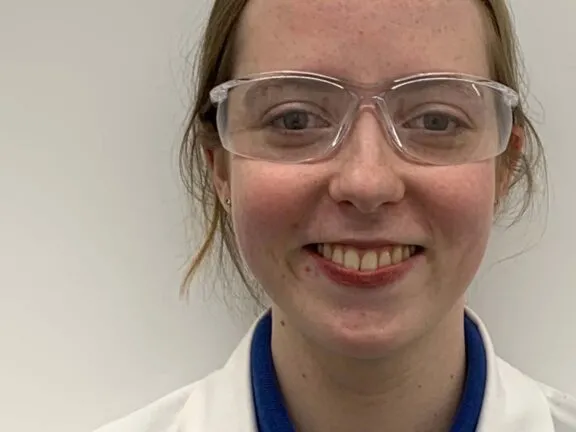
Meet Elizabeth Bywater
“I really enjoy being in the lab – it’s varied, hands-on and much more interesting than sitting at a desk all day.”
Meet Elizabeth Bywater
- Job Title: Production Chemist
- Company: Endeavour Speciality Chemicals Ltd
- Degree: MChem Chemistry, University of Bath
Discovering Chemistry at School
At school, Elizabeth was drawn naturally towards science. She studied chemistry, biology and maths at A level.
“I didn’t really get along with physics,” she laughs. “But I really enjoyed biology and chemistry.”
While she liked biology, it was the practical lab work that stood out most. That preference eventually led her to chemistry, which offered more time experimenting and problem-solving in the lab.
“I was choosing between chemistry and natural sciences,” she explains. “But I preferred the practical labs you get with chemistry.”
Choosing University and a Practical Path
Elizabeth went on to study Chemistry at the University of Bath, completing a four-year integrated Master’s degree (MChem).
“I didn’t do a placement year,” she says, “but the course was very lab-focused, which I really liked.”
Visiting universities and experiencing their practical sessions helped confirm her decision. Being hands-on in the lab mattered more to her than theory-heavy courses.
Finding the Flavour Industry
After graduating, Elizabeth began applying for jobs, a process that took some time.
“I knew I wanted to work in a lab after graduating,” she says. “I always preferred organic chemistry, and I didn’t want to be sitting in an office all day.”
The opportunity at Endeavour Speciality Chemicals came through a recruitment agency and immediately stood out.
“The role sounded really interesting and it was exactly what I was looking for.”
Nine months into the job, Elizabeth is already building a strong foundation in production chemistry within the flavour industry.
What Does a Production Chemist Do?
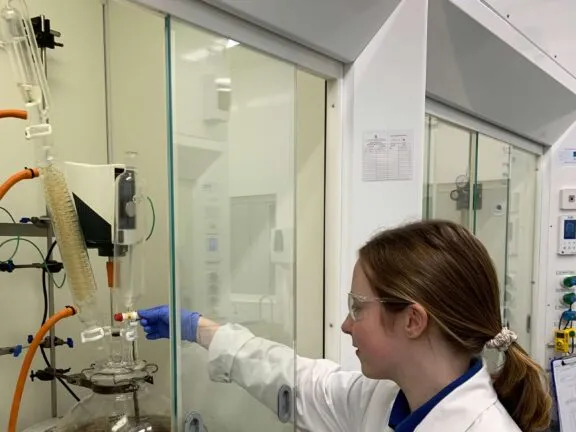
Elizabeth works in Endeavour’s sulphur production lab, manufacturing aroma chemicals used in flavour applications.
“We’re given a product to make, along with the process instructions,” she explains. “We set up the reactions, monitor them using gas chromatography and then carry out distillations.”
A key part of the role involves handling air- and moisture-sensitive chemicals such as lithium aluminium hydride and butyl lithium. These materials require careful technique, strict safety procedures and a solid understanding of reaction chemistry.
Reactions can involve controlled additions of multiple chemicals and in the sulphur lab this sometimes includes gassing reactions using methyl mercaptan or hydrogen sulphide. These processes demand close monitoring and careful control to ensure both safety and product quality.
Inside the Different Labs
Endeavour’s production department is split into two main labs:
- Lab 1: Sulphur lab
- Lab 2: Non-sulphur lab
“The labs have very different smells,” Elizabeth notes.
While she currently works in the sulphur lab, there may be opportunities to move between labs in the future.
“If I asked, I think I’d be able to move once I’ve finished my training,” she says.
Each lab uses slightly different equipment and processes, something Elizabeth finds exciting. She’s particularly keen to try out the large rotary evaporator used in the non-sulphur lab.
A Typical Day in the Lab
Elizabeth starts work early, with the day beginning at 7:30am.
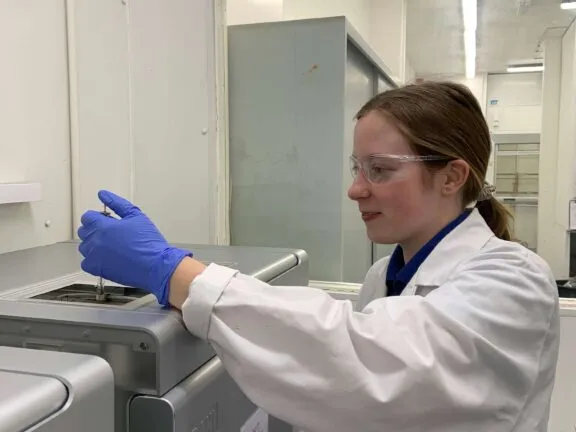
If reactions are already running, the morning may involve sampling and checking progress using gas chromatography. If a reaction hasn’t fully completed, adjustments might be needed, such as adding further reagents, controlling addition rates or applying more heat.
Many days involve setting up new reactions from scratch. This can mean carefully charging vessels with starting materials, carrying out staged additions of reagents or introducing gases under controlled conditions. Some reactions require frequent additions throughout the day, while others run over longer timescales.
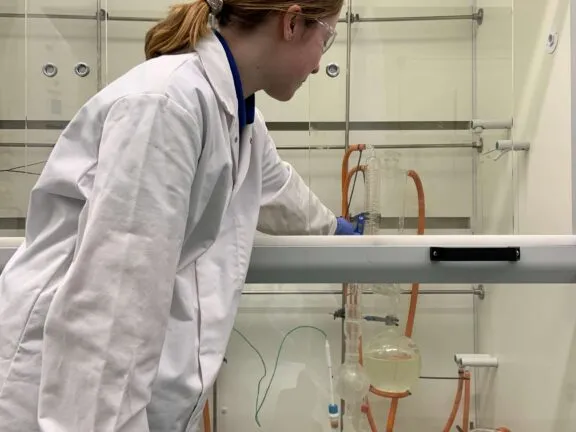
Once reactions are complete, the focus shifts to work-up and purification. Distillations may take place under vacuum or at atmospheric pressure, depending on the boiling point and sensitivity of the compound. Elizabeth often manages several processes at once, balancing active reactions with cleaning equipment, preparing dilutions and supporting colleagues where needed.
“No two days are really the same,” she says. “You’re always doing a mix of different things.”
Some products are completed within a week or two, while others can take much longer from start to finish.
Once a reaction is complete, the mixture is “worked up” in preparation for purification. Distillation plays a major role in the process and may be carried out either at atmospheric pressure or under vacuum, depending on the product specifications.
After distillation, samples are assessed by Quality Control. In addition to odour evaluation, products may be tested for specifications such as assay, isomer ratios or acid value. Once approved, the finished material is formally logged into the company system. From there, it can be used to fulfil customer orders, held as stock or used in further reactions or dilutions.
Elizabeth is still in training, but she’s already gaining experience across a wide range of reactions, techniques and production-scale processes.
The Impact of Aroma Chemicals
One of the most striking parts of Elizabeth’s role is seeing just how powerful aroma chemicals can be.
“We make a grapefruit compound that you can still smell at one part per billion,” she explains. “It’s used in things like grapefruit gin and tonic.”
It’s a reminder that even tiny amounts of these chemicals can have a huge sensory impact and that precision in production is essential.
What Elizabeth Enjoys Most
Unsurprisingly, the highlight of Elizabeth’s role is being in the lab.
“I really enjoy it,” she says. “It’s very different to working in an office every day.”
She also appreciates the occasional opportunities to experience other parts of the business. From helping with stock checks to supporting Quality Control when teams are short-staffed, the company encourages flexibility and learning.
Developing Skills on the Job
Since joining Endeavour, Elizabeth feels her practical lab skills have developed significantly.
“At university, we worked on a much smaller scale,” she explains. “Now we’re using 5, 10 and 20-litre reaction vessels.”
She’s gained hands-on experience handling sensitive reagents, running distillations under vacuum and working with gassing reactions. Gas chromatography, which wasn’t a major focus during her degree, is now a key part of her daily work.
The move from academic lab work to industrial-scale production has strengthened both her technical confidence and her understanding of process chemistry.
Career Progression & Opportunities
Elizabeth is currently a Junior Production Chemist, with clear progression ahead.
After completing her training and gaining experience, she can move into a Senior Production Chemist role. Beyond that, there are opportunities to become a Lab Manager, overseeing work within a specific lab, or move into broader management roles.
“There are also people who move from production into R&D,” she says, where chemists work on developing new chemicals or improving existing processes.
Elizabeth is clear that there are many chemistry-related career paths within the company.
Advice for Students Interested in Flavours
Elizabeth admits she hadn’t realised how large the flavour industry was before joining it.
“There are lots of roles available,” she says.
Her advice to students is to be strategic during university:
“If you can, choose modules that are relevant. Looking back, there were some options I could have taken that would have been really useful for this role.”
Practical experience, confidence in the lab and a solid grounding in organic chemistry can all make a real difference.
Final Thoughts
Elizabeth’s experience highlights how a love of practical chemistry can lead to a fulfilling, hands-on career in the flavour industry. From handling sensitive reagents and running complex reactions to purifying and approving finished aroma chemicals, production chemistry offers real responsibility and tangible results.
With clear progression routes, varied work and constant learning, it provides an engaging alternative to office-based roles.
For students who enjoy lab work and want to see chemistry in action on an industrial scale, Elizabeth’s path shows just how many opportunities are available.